A Corrugated Culvert Pipe carries water beneath roads, driveways, railways, and embankments. Its ridged profile adds strength while keeping the material relatively light. Picture a steel or polymer pipe beneath a gravel road, surrounded by compacted soil and moving runoff. That interaction matters.
The Federal Highway Administration’s Hydraulic Design of Highway Culverts, HDS-5, identifies inlet control, outlet control, headwater, tailwater, and debris as key design factors. The American Society of Civil Engineers gave U.S. stormwater infrastructure a D grade in its 2021 Infrastructure Report Card. That finding gives culvert design a wider meaning. Drainage failures can interrupt transport, damage pavement, and erode nearby land.
David R. Smith of the National Corrugated Steel Pipe Association expresses the practical principle clearly: “A culvert is not just a pipe; it is a soil-structure system.” The statement deserves attention. A stronger pipe cannot compensate for poor bedding, uneven backfill, or an undersized inlet. Installation details often decide performance.
This guide explains what Corrugated Culvert Pipe is, how it works, and where it fits. It also considers steel, aluminum, and polymer options. Site conditions differ. So do budgets, loads, rainfall patterns, and maintenance expectations. A design that performs well under a rural driveway may struggle beneath a busy highway.
Some assumptions need checking. Bigger is not always better. Cheaper is not always economical. Proper hydraulic calculations, material selection, and field inspection remain essential.
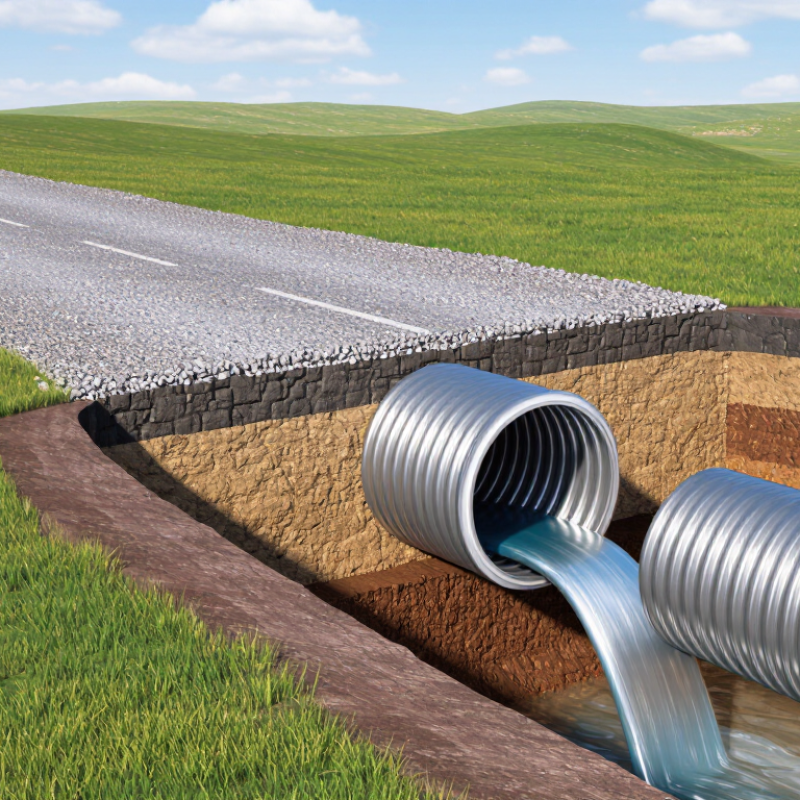
A corrugated culvert pipe is a drainage tube with repeated ridges along its wall. These corrugations improve stiffness without requiring a solid, heavy section. The pipe usually carries stormwater beneath roads, driveways, rail paths, and earth embankments. It may be made from galvanized steel, aluminum, or high-density polyethylene. Each material behaves differently in soil, water, and changing temperatures.
The pipe collects runoff and directs it through a controlled underground route. Its ribbed exterior grips the surrounding backfill, while the smooth or partly smooth interior helps water flow. Pipe diameter, slope, cover depth, and expected water volume must match the site conditions.
A civil contractor normally checks these factors before installation. A poorly sized pipe can overflow during intense rain. That detail is often underestimated.
Installation quality matters just as much as pipe selection. Workers should prepare a stable trench, remove sharp stones, and place suitable bedding beneath the pipe. Backfill should be added in balanced layers and compacted around both sides. Uneven pressure can deform the pipe. Small errors matter. In my experience, drainage failures often begin with rushed compaction or blocked inlets. Regular inspections should look for sediment, crushed sections, joint movement, and erosion near the outlet. No design remains perfect after every storm, so local soil and rainfall records deserve another review before construction.
A corrugated culvert pipe carries stormwater beneath roads, railways, driveways, and embankments. Its repeated ridges are more than surface decoration. They increase the pipe’s moment of inertia, helping it resist bending under soil and traffic loads. The valleys provide flexibility, while the ridges distribute pressure around the circular wall.
The pipe works with the surrounding soil. Federal Highway Administration guidance in Hydraulic Design of Highway Culverts, HDS-5, treats this as a soil-structure system rather than a standalone shell. Proper backfill supports the pipe and limits deformation. Poor compaction can cancel much of corrugation’s structural benefit.
For thermoplastic corrugated pipe, AASHTO M294 specifies a minimum pipe stiffness of 46 psi at 5% deflection for applicable sizes. This figure is a useful benchmark, not a universal guarantee. Diameter, cover depth, bedding quality, temperature, and groundwater can change field performance. Larger ridges generally improve stiffness, but they may also complicate connections and cleaning.
In practice, installation controls the result. A crew should place suitable granular bedding, compact haunch material carefully, and inspect the pipe before covering it. Small gaps beside the lower sidewall matter. They create weak zones.
Corrugated steel pipes follow the same basic principle, but thickness, coating, corrosion exposure, and soil chemistry require separate checks. The National Corrugated Steel Pipe Association’s design guidance emphasizes these variables. A design based only on pipe diameter is incomplete, and sometimes dangerously convenient.
A corrugated culvert pipe carries water beneath roads, driveways, and rail embankments. Its ridges stiffen the wall, helping it resist soil pressure while remaining relatively light. In practice, material choice often determines service life. High-density polyethylene resists corrosion in many wet soils. Galvanized or coated steel provides strong structural performance, but harsh water can damage protective layers. Aluminum is lightweight and corrosion-resistant, although it needs careful support during backfilling. Concrete culverts offer high stiffness, yet they are heavier and usually are not called corrugated pipe.
Shape affects both flow and installation. Round pipes are common because they distribute pressure efficiently. Elliptical and horizontal-oval pipes can fit beneath shallow roads. Arch shapes may preserve waterway space where vertical clearance is limited. Box-shaped culverts suit wide channels, though they require more complex construction. Available diameters may range from about 300 millimeters to several meters, depending on local standards and project calculations. Larger is not automatically better. Oversizing can increase cost and complicate bedding.
Engineers select size by reviewing rainfall, drainage area, slope, soil cover, and expected traffic loads. Field crews should check the trench base before placing the pipe. Uneven bedding can create stress points. Backfill must be placed in balanced layers and compacted beside the haunches. A clean installation can still underperform if the outlet erodes. That detail is easy to miss. Material tables and hydraulic calculations should be verified against local requirements, because soil chemistry and freeze-thaw conditions can change the practical choice.
This chart compares representative Manning’s roughness coefficients for common culvert pipe materials. A lower value generally indicates less resistance to water flow, although actual performance depends on corrugation depth, pipe diameter, slope, joints, sediment, and installation conditions.
Corrugated culvert pipes are commonly manufactured from galvanized steel, aluminum, or high-density polyethylene (HDPE). They are available in round, pipe-arch, and elliptical shapes. Diameters and equivalent dimensions are selected according to expected flow, cover depth, roadway loading, soil conditions, and available space.
A corrugated culvert pipe is a strong, ridged tube designed to move water beneath roads, driveways, rail paths, and embankments. Its repeated ribs improve flexibility and help it tolerate shifting soil better than many smooth-wall pipes. Common materials include galvanized steel and high-density polyethylene. The correct choice depends on soil conditions, traffic loads, water flow, and expected service life.
Road drainage is one of its most visible applications. During heavy rain, a properly sized pipe carries runoff beneath a roadway instead of allowing water to weaken the pavement. Contractors also install culvert pipes beneath farm entrances, parking areas, and construction access roads. A small driveway crossing may need only a short section, while a highway crossing requires careful hydraulic and structural calculations. Details matter.
Agricultural drainage uses corrugated culverts to connect field ditches, control standing water, and maintain access between plots. They also support stormwater systems near buildings and industrial sites. In sloped areas, inlet protection can reduce erosion, while outlet protection helps prevent soil from washing away. Field inspections often reveal problems caused by poor bedding or blocked ends. That is easy to overlook. Installers should check pipe alignment, cover depth, slope, and connections before backfilling. No site is perfectly predictable, so local rainfall patterns and soil movement deserve practical attention.
| Common Application | Primary Function | Typical Pipe Diameter | Typical Installation Location | Important Design Considerations |
|---|---|---|---|---|
| Roadway Crossings | Conveys streams, ditches, and stormwater beneath roads while maintaining the road embankment. | 300–1,500 mm (12–60 in) | Under local roads, driveways, rural roads, and access routes. | Hydraulic capacity, cover depth, traffic loading, inlet and outlet protection, and proper backfill compaction. |
| Highway and Large Embankment Drainage | Moves concentrated runoff through substantial earth fills and transportation corridors. | 600–3,000 mm (24–120 in), subject to site design | Beneath highways, rail approaches, and large roadway embankments. | Structural strength, allowable cover, live loads, corrosion or abrasion exposure, and maintenance access. |
| Agricultural Field Drainage | Drains excess surface water and carries flow across fields, farm tracks, and irrigation areas. | 200–900 mm (8–36 in) | Below farm roads, drainage channels, field entrances, and low-lying farmland. | Sediment control, adequate slope, protection from equipment loads, and resistance to chemically aggressive soil or water. |
| Stormwater Conveyance | Collects and transports runoff from developed or paved areas to an approved discharge point. | 300–2,400 mm (12–96 in) | Along site boundaries, beneath parking areas, and between drainage structures. | Design storm, inlet capacity, pipe slope, water velocity, outlet energy dissipation, and access for inspection. |
| Driveway and Property Access | Maintains drainage flow through a roadside ditch beneath a driveway or entrance. | 300–600 mm (12–24 in) | Residential, agricultural, industrial, and construction-site entrances. | Minimum diameter requirements, driveway load, end treatment, ditch alignment, and prevention of blockage. |
| Construction Site Dewatering | Provides temporary or permanent flow paths for groundwater, runoff, and pumped water. | 150–900 mm (6–36 in) | Around excavations, temporary access roads, work pads, and drainage channels. | Temporary load conditions, ease of removal, outlet erosion, sediment management, and site safety. |
| Stream and Ditch Crossings | Allows water to pass beneath a trail, road, or embankment without creating an open crossing. | 450–1,800 mm (18–72 in) | At natural channels, drainage swales, recreational trails, and access crossings. | Peak flow, debris passage, inlet and outlet stability, fish or wildlife requirements, and floodplain regulations. |
| Subsurface and Foundation Drainage | Collects or redirects water around foundations, retaining walls, and buried structures. | 100–450 mm (4–18 in) | Adjacent to foundations, retaining walls, landscaped areas, and underground utilities. | Perforation requirements, filter fabric, clean drainage aggregate, outlet location, and protection against clogging. |
A corrugated culvert pipe carries water beneath roads, driveways, and embankments.
Its ridges add strength while keeping the pipe relatively light. Choosing the right pipe starts with rainfall, drainage area, soil, traffic load, and allowable cover. Start with the outlet. Use local rainfall-frequency data, such as NOAA Atlas 14, to estimate design flow. Then check diameter and slope with FHWA Hydraulic Design Series No. 5. FHWA HEC-22 lists a Manning roughness coefficient near 0.024 for corrugated metal interiors, which affects flow capacity. A larger diameter is not always better. Outlet erosion and inadequate inlet protection can create new problems.
Installation quality often matters more than the pipe label. Prepare a firm, uniform trench bottom without sharp rocks. Place suitable bedding beneath the full pipe width. USDA NRCS National Engineering Handbook, Part 650, Chapter 8, stresses controlled bedding and backfill placement. Compact backfill in thin, even layers on both sides. Keep the pipe aligned. Avoid pushing heavy equipment directly over shallow cover. The exact minimum cover depends on pipe material, diameter, soil, and live loads. Follow the engineered installation detail, not a convenient guess. Small mistakes become expensive.
Inspect the inlet, outlet, joints, and surrounding ground after major storms. Remove sediment before it reduces capacity. Look for dents, rust, separated joints, sinkholes, and woody roots. FHWA’s Culvert Inspection Manual supports routine condition ratings and recorded observations. Photos help compare changes over time. I have seen clean-looking inlets hide settlement beneath the roadway. That is easy to miss. A maintenance plan should include seasonal checks, but actual intervals may need adjustment after unusual rainfall. Perfect assumptions are rarely available. The design should be reviewed when land use or drainage patterns change.
It carries stormwater beneath roads, driveways, rail paths, and earth embankments. Its ridged wall improves stiffness. Water follows a controlled underground route.
Repeated ridges help the wall resist bending and soil pressure. The valleys add flexibility. The surrounding backfill also supports the pipe.
Common choices include galvanized steel, aluminum, and high-density polyethylene. Each material reacts differently to soil, water, and temperature changes. The cheapest option may not last longest.
Round pipes distribute pressure efficiently and suit many installations. Oval or arch shapes can help where road cover is shallow. Box shapes fit wider channels but require more complex construction.
Designers review rainfall, drainage area, slope, soil cover, and traffic loads. The diameter must match expected water volume. Larger is not always better.
Workers should prepare a stable trench and remove sharp stones. Suitable granular bedding supports the pipe evenly. Small hard objects can create stress points.
Backfill should be placed in balanced layers around both sides. Careful compaction supports the haunches and limits deformation. Rushed compaction can cause hidden weak zones.
Inspections should check sediment, blocked inlets, crushed sections, joint movement, and outlet erosion. Look after heavy rain. Small problems can grow quickly.
No design remains perfect under every soil and rainfall condition. Groundwater, freeze-thaw cycles, and soil chemistry can change performance. Local records deserve another review.
A Corrugated Culvert Pipe is a drainage conduit designed to carry water beneath roads, driveways, railways, and other surfaces. Its ridged exterior increases structural strength by helping the pipe resist soil pressure and distribute loads more effectively than a smooth, thin-walled pipe. Corrugated culvert pipes may be manufactured from materials such as metal or plastic and are available in different diameters, lengths, and cross-sectional shapes to suit various flow requirements and site conditions.
These pipes are commonly used for stormwater management, roadside drainage, stream crossings, agricultural water control, and temporary or permanent access routes. Choosing the right pipe requires evaluating water volume, soil conditions, expected traffic loads, installation depth, and local environmental factors. Proper installation includes preparing a stable foundation, maintaining the correct slope, sealing or connecting sections securely, and covering the pipe with suitable backfill. Regular inspections can identify blockages, erosion, deformation, or joint problems early, helping maintain reliable drainage and extend the pipe’s service life.

Changhong